


By: Victor Lee
In 1943, Abraham Maslow published a seminal paper called A theory of human motivation in which he described a hierarchy of 5 human needs, with the satisfaction of each need being a prerequisite for addressing the next higher need. The two most basic needs are physiological (e.g., food, water) followed by safety (e.g., physical security, undisrupted routines). When these basic needs are met, they are followed by psychological needs such as love (e.g., belongingness, intimate relationships) and esteem (feeling of adequacy/accomplishment, recognition, respect from others). Only when all of the aforementioned needs are satisfied can a person address self-actualization needs (i.e., becoming everything that one is capable of becoming).
There is an analogous hierarchy of needs related to healthcare interoperability. Healthcare providers, payers, information exchanges, analytics companies, and many other organizations implement various kinds of health IT systems, and along with those investments come the promise of improved administrative, clinical, and financial outcomes, better patient and provider satisfaction, or other expectations depending on the kind of health IT system in focus. These represent our aspirational goals and the manifestation of our healthcare system becoming everything that it is capable of becoming. But how do our health IT investments help us achieve self-actualization when it’s difficult to get an accurate understanding of what is happening with our patients because their data are fragmented? Patients invariably receive care from multiple providers, multiple locations, and multiple organizations, so it is imperative that data can flow from system to system in an interoperable manner. This allows permitted users of the data to access all relevant information about the patient from any source to generate a composite view of the patient record, draw the right conclusions, and make the best decisions based on that data.
The most basic need related to healthcare interoperability is digital transformation. The ability to capture and store patient data in electronic format lays the foundation for an ecosystem that establishes electronic health information as the new currency for unlocking value from our health IT investments. Market drivers for digital transformation extend decades into the past and are too numerous to address comprehensively in this discussion, but let’s examine some relatively recent legislative and regulatory actions that have influenced our nation’s digital transformation. For providers, the implementation of electronic health records (EHRs) was stimulated by American Recovery and Reinvestment Act of 2009 which gave birth to the Centers for Medicare and Medicaid Services (CMS) EHR Incentive Program (a.k.a. “Meaningful Use” and now known as the Promoting Interoperability Program). For health IT vendors (e.g., EHR, laboratory information system, ePrescribing, and other software vendors that support healthcare delivery), the same legislation gave rise to the Office of the National Coordinator for Health Information Technology (now known as the Assistant Secretary for Technology Policy or ASTP) Health IT Certification Program, and health IT adoption rates are rigorously tracked through numerous ASTP data briefs. For health information networks and their constituents, the Trusted Exchange Framework and Common Agreement (TEFCA) originated from the 21st Century Cures Act of 2016 and provides a common set of principles, terms, and conditions to support nationwide exchange of electronic health information. For payers, the CMS Interoperability and Patient Access Final Rule (CMS-9115-F) mandates the implementation of Fast Healthcare Interoperability Resources (FHIR)-based APIs to facilitate data exchange between health plans, providers, and patients, and it also originated from the 21st Century Cures Act of 2016.
When digital transformation is achieved, the next healthcare interoperability need is to develop technical standards for patient data exchange. These technical standards are also too numerous to address comprehensively, but I’ll provide examples in two categories of technical standards. One category relates to message structure for data transport. Fast Healthcare Interoperability Resources (FHIR) is a data exchange framework that is designed to facilitate seamless data sharing between healthcare systems using web-based technologies such as RESTful APIs. Health Level Seven Version 2 (HL7 v2) is a widely used messaging standard for exchanging healthcare data between EHRs, laboratory systems, billing platforms, and other entities. The Continuity of Care Document (CCD) is a standardized format for sharing patient summary data between healthcare providers, typically during care transitions (e.g., hospital discharge, referrals) and is widely used in EHRs and health information exchanges. Another category of technical standards relates to security. Open Authorization (OAuth) is used for secure API authorization (e.g., for SMART on FHIR or other third-party health apps), Transport Layer Security (TLS) is used for secure data transmission (e.g., for FHIR and HL7 v2 data exchanges), and Security Assertion Markup Language (SAML) is used for single sign-on (e.g., for enterprise healthcare logins) to name a few. These technical standards are akin to the transportation infrastructure that enables motorized vehicles to drive to almost any address in the country.
The next healthcare interoperability need is for semantic standards for patient data exchange. If technical standards represent our roadways, then semantic standards represent the contents that are being transported on our roadways. Semantic standards bring uniformity to the meaning of encoded patient data. The United States Core Data for Interoperability (USCDI) is a set of health data classes and their respective data elements that are the building blocks for nationwide interoperable exchange of patient data. USCDI specifies the applicable terminology standards that should be used for various purposes. For example, SNOMED CT or ICD-10-CM should be used for the interoperable exchange of diagnoses/problems, RxNorm should be used for the interoperable exchange of medications, and LOINC should be used for the interoperable exchange of lab results. When local terminologies are mapped to standard terminologies, the normalized representation of concepts allows any recipient of the patient data to understand the meaning of the data that are transmitted.
While the health IT ecosystem has invested heavily in digital transformation and the maturation of technical and semantic standards, this brings us to our next healthcare interoperability need which is often overlooked: data quality. Let’s begin by describing some components of data quality. A good place to start is by understanding the Healthcare Data Quality Taxonomy that is central to the Patient Information Quality Improvement (PIQI) Framework:
| Categories & Dimensions | Examples |
|---|---|
| Availability: Are data missing, unpopulated, or incomplete? | An electronic laboratory reporting message is missing a patient’s zip code; the unavailability of the zip code makes it impossible to determine which public health jurisdiction should be notified if the message indicates the presence of a nationally notifiable disease |
| Accuracy: Do the data have invalid values, groupings, or formats? | A zip code of 02111 is inaccurately represented as a numeric data type and is therefore transmitted as 2111, whereas it should have been represented as a string data type that preserves the leading zero |
| Conformity: Do the data have invalid members, or are they incompatible or obsolete? | A lab result is transmitted in HL7 v2 format in which the specimen segment contains SNOMED CT code 26604007 and a description of “whole blood”. However, that code actually represents the concept of “Complete blood count” under the procedure hierarchy and is therefore incompatible with the lab test |
| Plausibility: Are data implausible due to clinical, situational, or temporal reasons? | A CCD message indicates that a patient’s height is 170 inches; that translates to more than 14 feet tall and is implausible, so there is likely to be an error with the value and/or the unit of measure |
Table. PIQI Healthcare Data Quality Taxonomy. Data quality issues fall into 4 categories, each with different dimensions. An example from one dimension in each category is provided.
According to the 2024 Healthcare Data Quality Report, survey respondents across a variety of market segments had mixed perceptions of the quality of their own data and even worse perceptions of the quality of external data sources. It is therefore not surprising that many organizations are hesitant and unlikely to integrate external data into their enterprise. Watch a replay of A Year in the Evolution of Data Quality for additional information about how it is now possible to proactively identify data quality issues so they can be fixed at the source.
The final need at the top of the hierarchy is for improved outcomes. The Mirror, Mirror 2024 report by the Commonwealth Fund shows that in comparison to other high-income nations, the United States overspends and underperforms in several performance domains. It is therefore incumbent upon us to achieve better outcomes for our money spent. Although there are many categories of outcome measures, we’ll focus on administrative, clinical, and financial outcomes. Examples of administrative outcomes include better staff productivity and efficiency related to information retrieval/sharing, clinical documentation, claims processing, and other operational objectives. Examples of clinical outcomes include reduction in mortality, morbidity, functional status, and quality of life. Examples of financial outcomes include savings due to reduced length of stay, lower emergency department and hospital readmissions, and overall lower cost of care while managing acute illnesses and offering preventive services to optimize health and wellness in patients and populations. Whether we refer to this goal as self-actualization, the Quadruple Aim, or the holy grail of healthcare, the bottom line is that our data-driven healthcare system will find it very difficult to get there without satisfying the dependent needs of digital transformation, technical standards, semantic standards, and data quality.
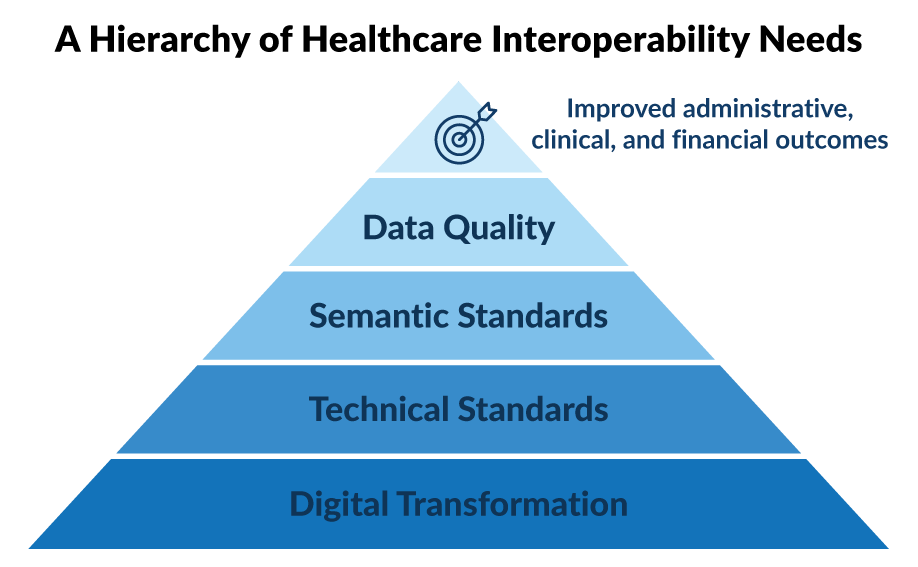
Figure. A Hierarchy of Healthcare Interoperability Needs. Digital transformation sets the stage for technical and semantic standards. With good data quality, we are most likely to succeed with improving outcomes.
In summary, our nation has made tremendous progress with healthcare interoperability. Digital transformation has skyrocketed, and technical and semantic standards have matured due to support from well-established standards development organizations that foster ongoing evolution through international working groups, hackathons, and electronic feedback loops. However, our focus must now shift to data quality. We are sitting on vast amounts of health data, yet their value is limited by inconsistencies, inaccuracies, and gaps. While data can be shared, it often cannot be effectively utilized and understood by other systems, thereby falling short of being truly interoperable. Without high-quality data, even the most advanced health IT infrastructure cannot deliver on its promise. Addressing data quality issues is the next critical step toward unlocking the full potential of our healthcare system—one that is truly data-driven, interoperable, and capable of improving patient outcomes at scale.